Summarize this page with
Guest checkout fraud prevention assesses an order without assuming a durable customer account already exists. Session evidence, order details and payment results become particularly important. Requiring every shopper to register is a product decision; it does not establish that the eventual payment is legitimate.
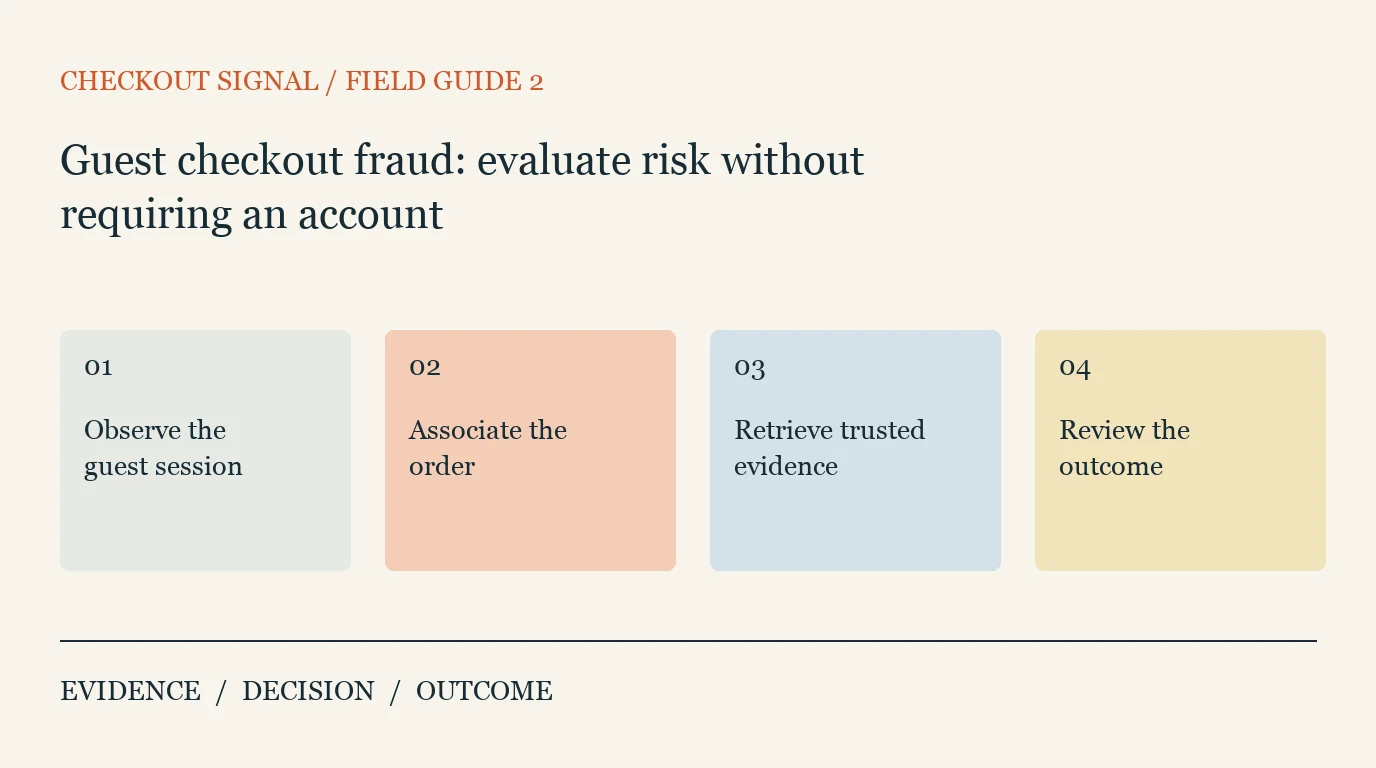
- 1Observe the guest session
- 2Associate the order
- 3Retrieve trusted evidence
- 4Review the outcome
Start with the guest evidence you actually have
A guest may use a new inbox, a shared tablet, an unfamiliar IP and a valid payment method. Each observation needs context. Collect supported device and network evidence, associate it with the order, and keep the payment result separate from the session score.
The Kount integration guide illustrates the importance of joining client collection and server order data with the same session identifier. Other providers have their own supported association fields.
Inspect the three decision layers
| Layer | Available question | Evidence to preserve |
|---|---|---|
| Session | What is known about this visitor and environment? | Collection reference, timing and named risk signals |
| Order | Does the requested purchase fit the available context? | Item, amount, delivery and supported customer details |
| Payment | What did screening and authorization return? | Decision, reason, authentication and transaction reference |
ShieldLabs supports visitor, user, device and IP risk context and account-abuse findings. For a guest with no associated account history, evaluate the available session result rather than expecting a complete account relationship on the first visit. Compare pre-payment and transaction tools.
Keep the order association stable
Create a server-controlled order reference before requesting the decision. Associate the supported collection identifier with that order. Verify that a later browser tab, another basket or a retry cannot accidentally reuse a result belonging to a different purchase.
Store the original result and the action taken separately. A customer may change the delivery address or payment method after the initial check; decide which changes require reassessment under your chosen integration. Do not treat a cached session verdict as an unlimited approval for every future order.
Give ambiguous guests a recovery route
A privacy relay or shared device can be legitimate. Inspect corroborating evidence before escalating. Depending on the flow, a supported authentication step, order review or customer confirmation may supply the needed evidence. Keep unresolved orders distinguishable from approved, declined and fulfilled orders.
An illustrative shared-household scenario contains two people buying from one tablet. The same device explains their relationship but does not by itself establish abuse. A contrasting controlled scenario can reuse one session for rapid attempts across unrelated identities. Keep these cases separate in the evaluation dataset.
Follow the result through fulfillment
Review completion, delivery changes, customer contact and eventual disputes. Compare guests with guests in similar regions, order types and payment methods. Established-account buyers have different available histories; combining the cohorts can hide which control creates friction.
Continue with false-decline measurement and the complete deployment guide.
FAQ
Can a guest be recognized without a login?
Supported device and visitor identification can provide returning-session context. Recognition does not establish the cardholder's identity or authorize a payment.
Should a new email cause a decline?
A new email is limited evidence. Combine supported session, order and payment context before choosing a response.
Does a risk score replace authentication?
No. Risk assessment and payment authentication serve different purposes. Evaluate the complete supported flow.
Continue reading
- How to stop card testing without locking out real customers
- How to measure false declines alongside missed payment fraud
Compare all ten tools or read the complete deployment guide.