Choosing and deploying payment fraud detection in 2026
A complete guide to the evidence layers, integration, actions, costs and evaluation questions behind a checkout stack.
How Does Payment Fraud Detection Work?
Payment fraud detection works in layers, because no single check sees the whole attack. A pre-payment layer identifies the user and device at signup, login, and checkout, a transaction layer scores the card and the order at authorization, and a dispute layer handles alerts and chargebacks after the payment has settled.
- Pre-payment identity: device identification, network checks, and automation detection answer whether a bot, device farm, or ring of accounts is behind the session before any payment exists.
- Transaction scoring: models read the card, the BIN, AVS and CVV results, the amount, and the order history, and processor-native tools add the payment volume they already see.
- Network intelligence: consortium vendors recognize a card or email flagged at another merchant, which helps most when the attacker has been active elsewhere.
- Dispute handling: card-network alerts, automated refunds, and representment act after authorization, when the fraud has already been paid for.
Much fraud is decided at the first layer and only shows up weeks later as a chargeback, which is why the layers complement rather than replace one another.
How to Detect Payment Fraud
To detect payment fraud, identify the device and network behind each signup, login, and checkout before the card is authorized, then look for automation, velocity, and linked accounts. Combine every signal into one risk score with named reasons, and act by risk level, so good customers pass while card testers and account farms are stopped.
- Identify the device. Assign a persistent device identifier at signup, login, and checkout so repeat attempts link to one actor even after cookies are cleared.
- Check the network. Flag VPN, proxy, residential proxy, Tor, and datacenter connections, and compare the IP location with the billing country and browser timezone.
- Detect automation. Look for headless browsers, anti-detect browsers, and scripted form fills, the tools that run card testing at scale.
- Measure velocity. Count cards, accounts, and failed authorizations per device and per account within short time windows.
- Link accounts. Connect signups and logins that share a device to expose multi-account rings and taken-over accounts before a saved card is charged.
- Score the evidence. Combine all signals into one weighted risk score with named reasons before the payment reaches authorization.
- Act by risk level. Approve low risk, step up medium risk with 3-D Secure, review single-signal high risk, and decline corroborated high risk.
What Is the Difference Between Payment Fraud Detection, Transaction Screening, and Chargeback Prevention?
These three terms describe different jobs, even though vendors use them loosely. Payment fraud detection is the umbrella for stopping fraudulent payments, transaction screening scores each payment at authorization, and chargeback prevention stops disputes from being filed or lost. Most merchants need at least two of them, often from different vendors.
- Transaction screening returns approve, review, or decline inside the checkout call, within a latency budget the payment flow can absorb.
- Chargeback prevention ranges from screening before authorization, to card-network alerts that let a merchant refund before a dispute posts, to guarantees that reimburse fraudulent chargebacks.
- Card testing detection is a special case: bots run many small authorizations to check stolen cards, so automation and velocity signals matter more than order history.
A practical pairing is one pre-payment identity layer plus the transaction and dispute tools your processor already offers.
How Do You Integrate Payment Fraud Detection?
You integrate payment fraud detection in one of three shapes: a toggle inside your processor, a server-side API call at authorization, or a client-side script with server verification. The shape sets latency, which processors are covered, and how much decision logic you maintain, so settle it before comparing detection quality.
- Processor-native: tools built into the processor start with processor-integrated deployment but cover only payments on that processor.
- Server-side API at authorization: the backend sends supported order, tokenized payment and customer attributes to the vendor and reads back a score or decision before capturing the payment.
- Client-side script plus server verification: a JS agent collects device and browser evidence at signup, login, and checkout, and the server fetches the verdict by request ID so a tampered client cannot forge it.
Run the check at signup, login, password reset, payment-method changes, and checkout rather than on every page view.
Decide up front whether a vendor timeout fails open, allowing and logging the payment, or fails closed with a challenge, and store the raw response with each decision so reviewers can see why an order was flagged.
What Should You Do When a Payment Is Flagged?
When a payment is flagged, tie each risk level to a graduated action instead of one global decline rule. A single weak signal is not proof of fraud, so low risk passes, medium risk gets a step-up such as 3-D Secure, and only corroborated high risk is declined or held for review.
- Low risk: approve with no added friction and keep the result for later analysis.
- Medium risk: step up with 3-D Secure at checkout, a one-time code at login, or email verification at signup.
- High risk on a single signal: hold the order for manual review before fulfilment.
- High risk with corroboration: decline, and lock the account or force a password reset when the device is linked to other flagged accounts.
Watch the approval rate as closely as the fraud rate. False declines can create substantial lost revenue, so a rule that blocks slightly more fraud while declining many more shoppers usually loses money.
How Much Does Payment Fraud Detection Cost at Your Volume?
Compare identification allowances, screened-payment plans, fraud checks and approved-order fees at the same workload. Include engineering, manual review, authentication and residual loss. Read the cost model and evaluation checklist.
How Will Payment Fraud Detection Change from 2026 to 2030?
Plan for changing automation, payment rails and customer behavior rather than treating a forecast as a product promise. Evaluate whether the stack can assess an authorized shopping agent, repeated card-testing automation and a legitimate privacy-conscious buyer differently.
Settlement, recall and dispute rights depend on the payment rail and agreement. Verify the decision deadline and recovery options for each supported method.
Which Payment Fraud Detection Tool Fits Which Scenario?
Pick the tool by the job it has to do and the payment stack you run, not by the length of its customer-logo wall. The first scenario below covers the pre-payment layer, and the rest cover transaction scoring, chargeback guarantees, bank-scale monitoring, fintech onboarding, and footprint enrichment, each matched to the vendors built for it.
- Ecommerce and fintech teams losing money to fake signups, account farms, and bots that surface as chargebacks: ShieldLabs, which identifies the user and device before checkout on any processor.
- Stripe-native businesses that want transaction scoring with an integrated deployment path: Stripe Radar.
- Larger teams that want consortium-scale transaction scoring: Sift or Kount.
- Merchants that want chargeback liability moved off their books: Signifyd, Forter, or Riskified.
- Banks and large fintechs that need transaction fraud plus AML: Feedzai.
- Fintechs running onboarding, ACH, and crypto flows: Sardine.
- Fraud and AML teams that want digital-footprint enrichment inside case management: SEON.
What Should You Verify Before Buying Payment Fraud Detection Software?
- Confirm payment methods, processors and selected product entitlements.
- Inspect result association, missing collection, timeout and retry handling.
- Use authorized controlled cases for automation, related accounts and repeated payment attempts.
- Measure legitimate completion, decision timing, review work and matured confirmed fraud.
- Read guarantee coverage, billing definitions and required claim evidence.
A fixed one-week trial cannot establish every delayed dispute outcome. Use an explicit observation window and retain unresolved cases separately.
How Do You Measure False Declines and Missed Fraud Together on Your Own Checkout Traffic?
Join the original risk decision, authentication, issuer response, order action and later dispute outcome using a stable reference. Separate control declines from issuer declines and timeouts. A retry, a successful later purchase or a chargeback is evidence to investigate, not an automatic ground-truth label.
Compare matched payment methods, regions and customer types with explicit denominators. Follow recovered legitimate orders and matured confirmed fraud separately. Read the full false-decline measurement guide.
Focused implementation guides
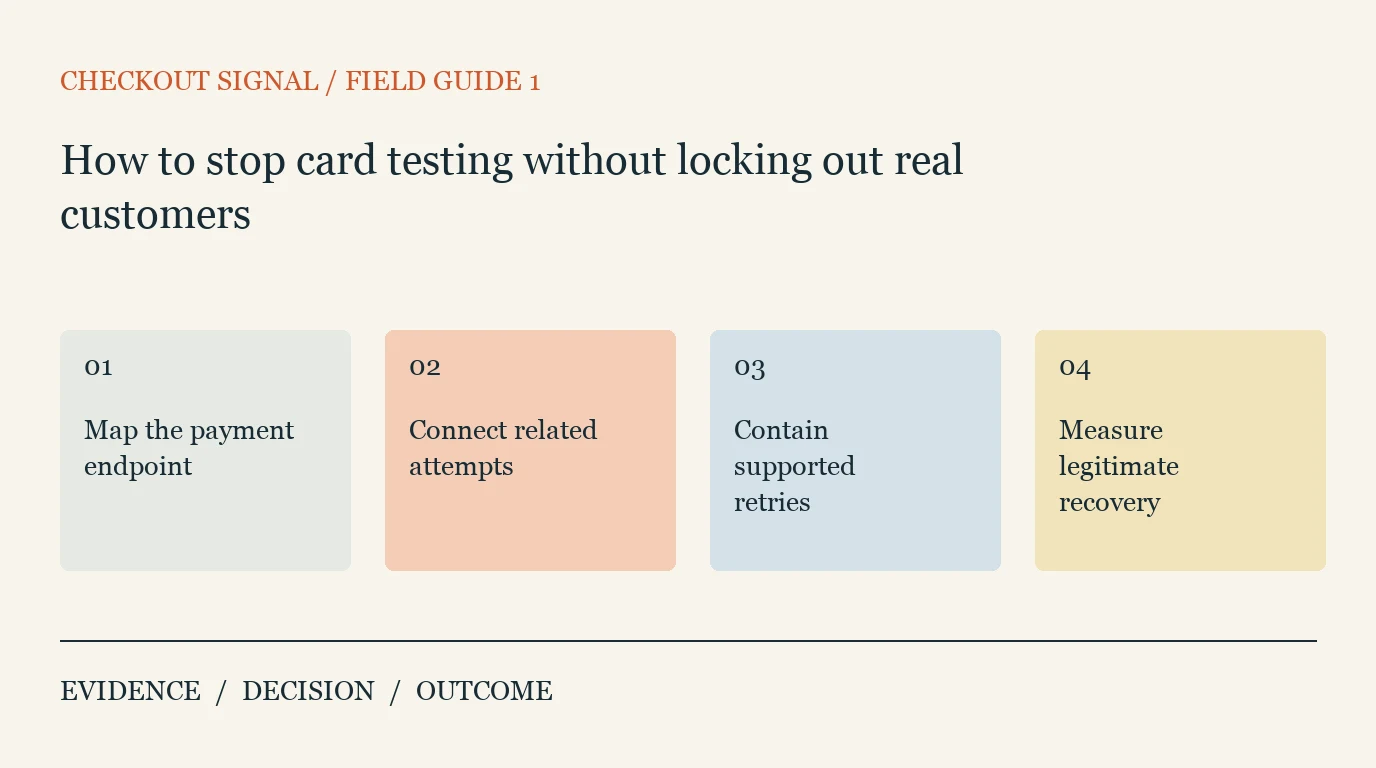
How to stop card testing without locking out real customers
Contain repeated payment probes across the checkout and its server endpoints, then measure legitimate completion and screened-attempt cost.
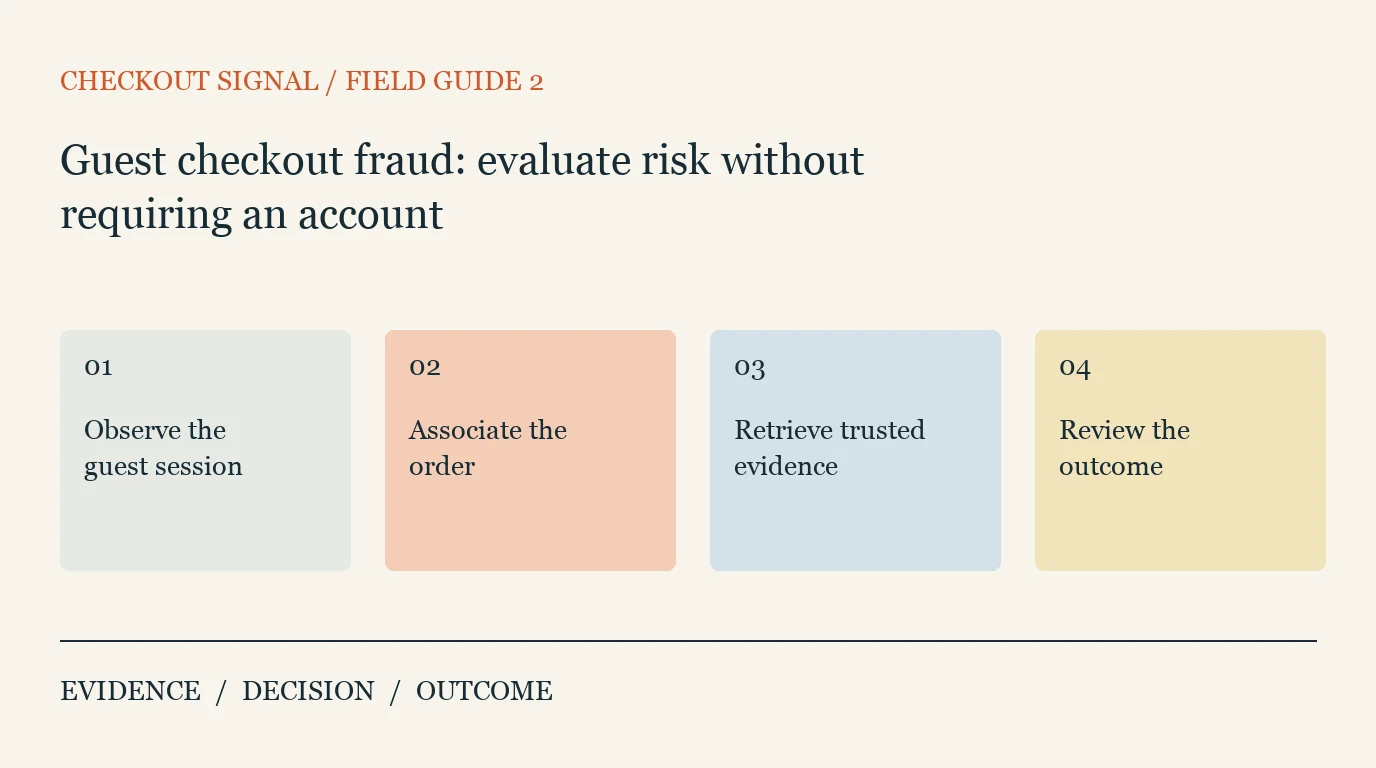
Guest checkout fraud: evaluate risk without requiring an account
Assess a new checkout with device, network, order and payment evidence while keeping a workable path for legitimate guests.
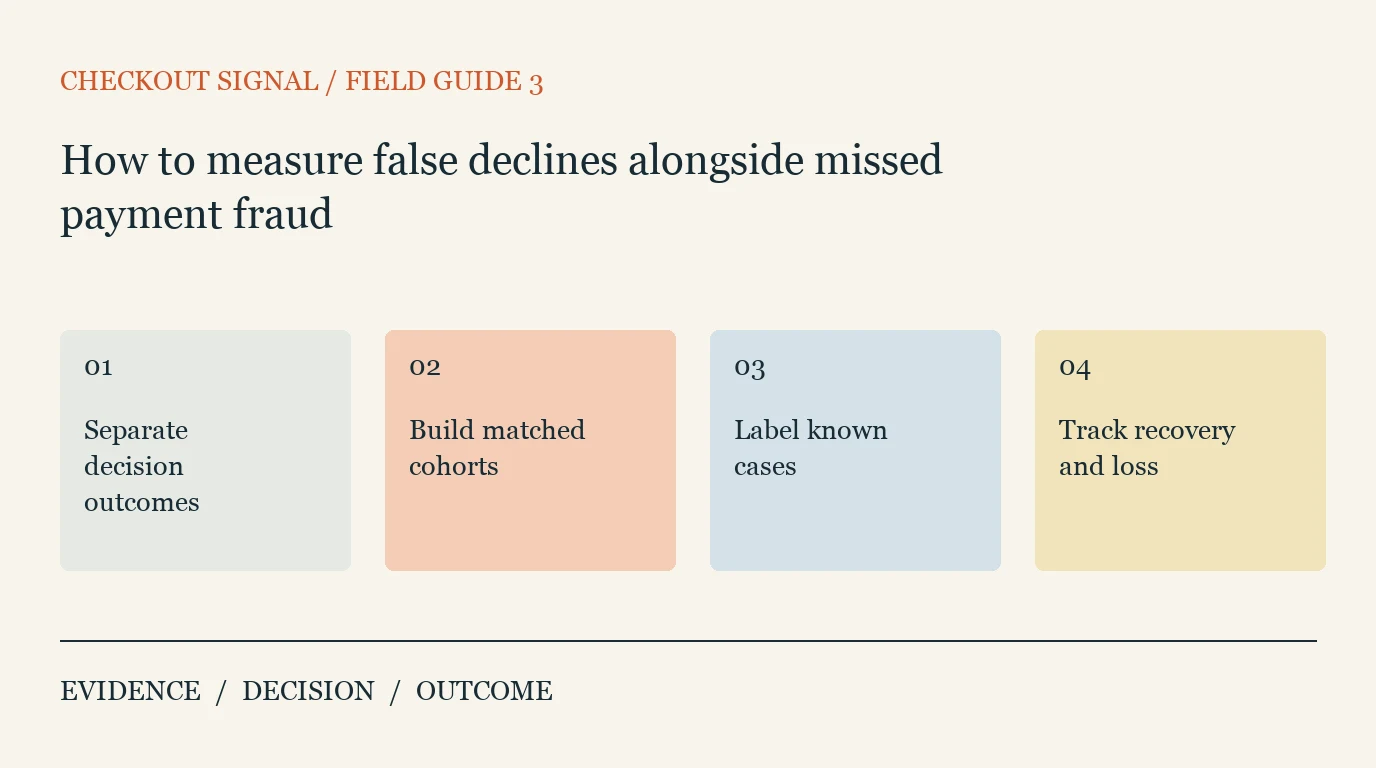
How to measure false declines alongside missed payment fraud
Define comparable checkout cohorts and explicit outcome denominators before judging whether a fraud control improves approvals.
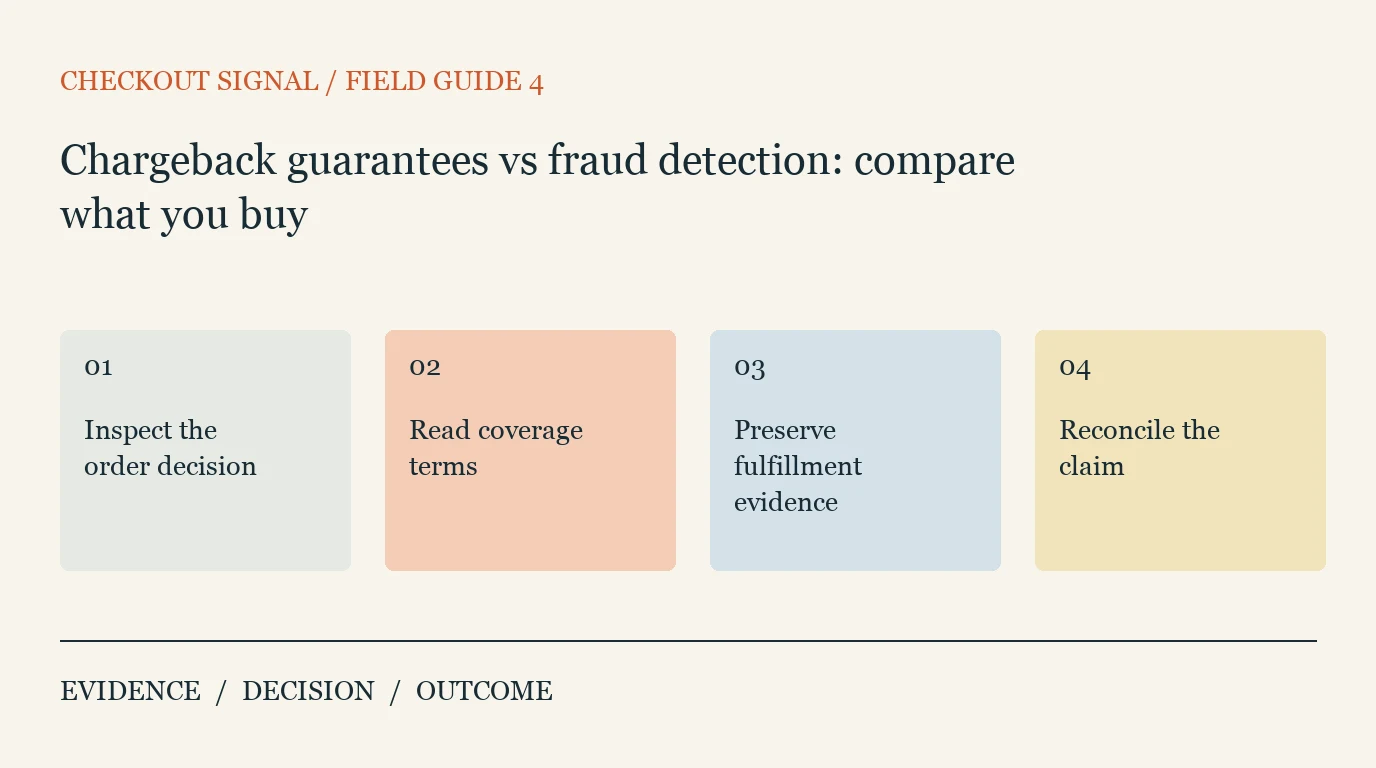
Chargeback guarantees vs fraud detection: compare what you buy
Compare transaction decisions, eligible reimbursement, disputes and residual obligations before selecting chargeback protection.
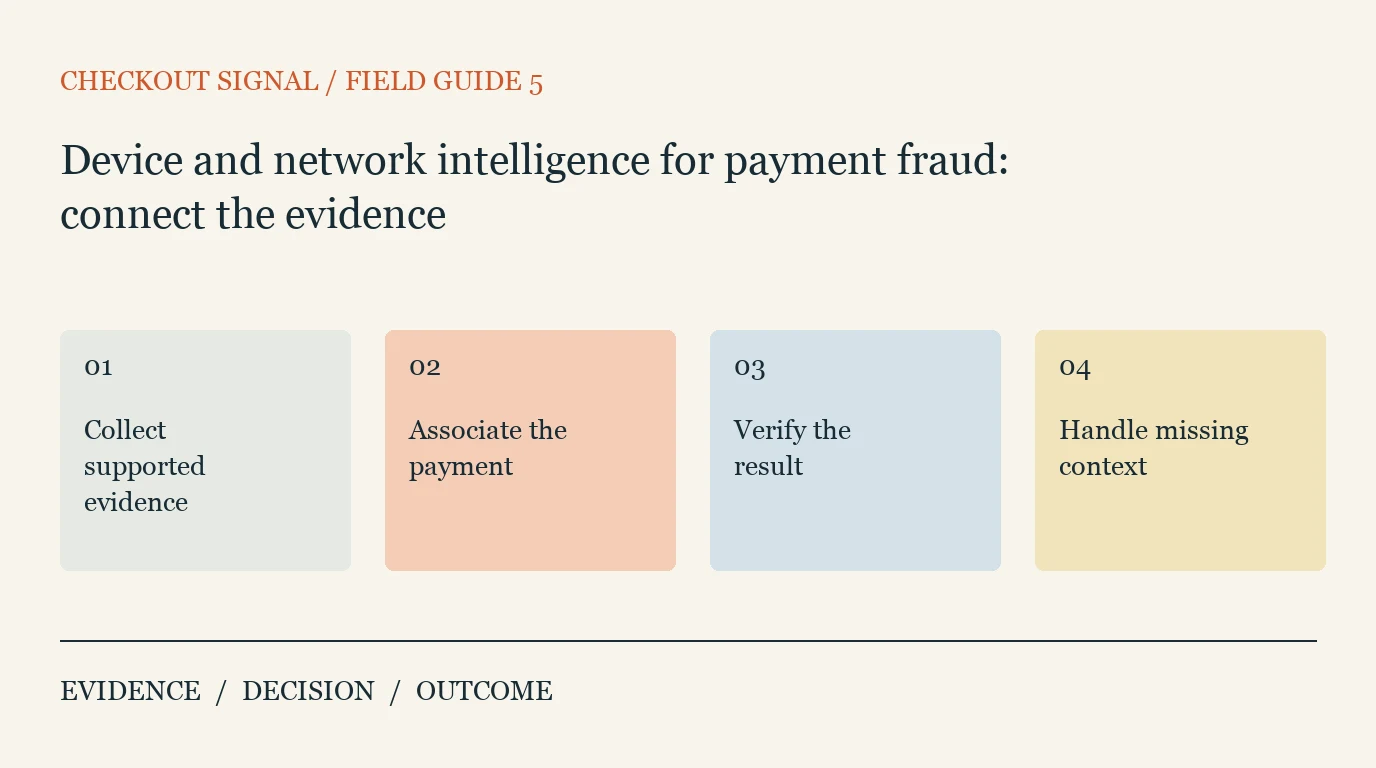
Device and network intelligence for payment fraud: connect the evidence
Connect current device, IP and account evidence to the payment attempt without turning a network flag into a universal decline rule.
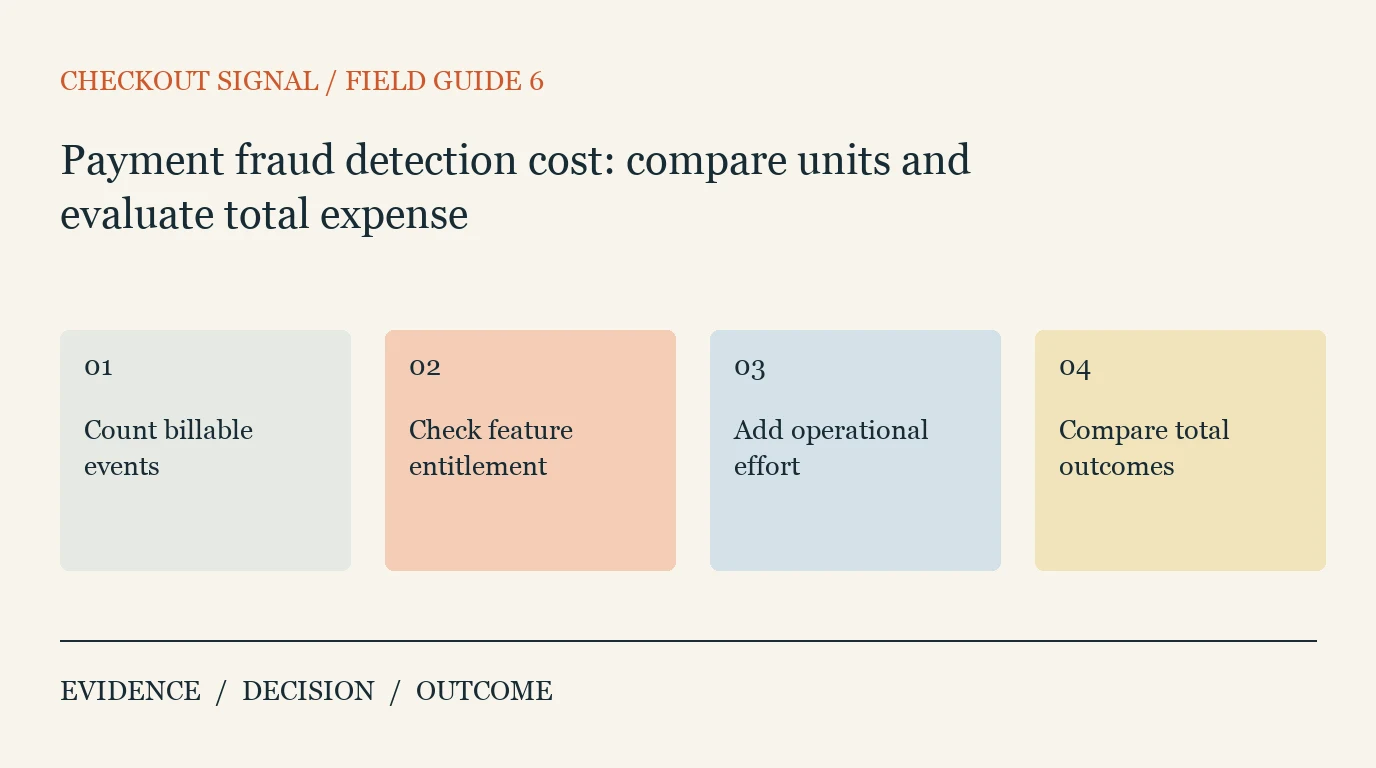
Payment fraud detection cost: compare units and evaluate total expense
Compare identification, screened-payment, fraud-check and approved-order fees with review work, authentication and residual loss.