Summarize this page with
A false decline is a legitimate purchase rejected by a control. Measuring it requires evidence that the customer or order was legitimate, not merely a rejected transaction. Evaluate approval, fraud loss, authentication and recovery together so a higher fraud-catch rate does not conceal avoidable lost sales.
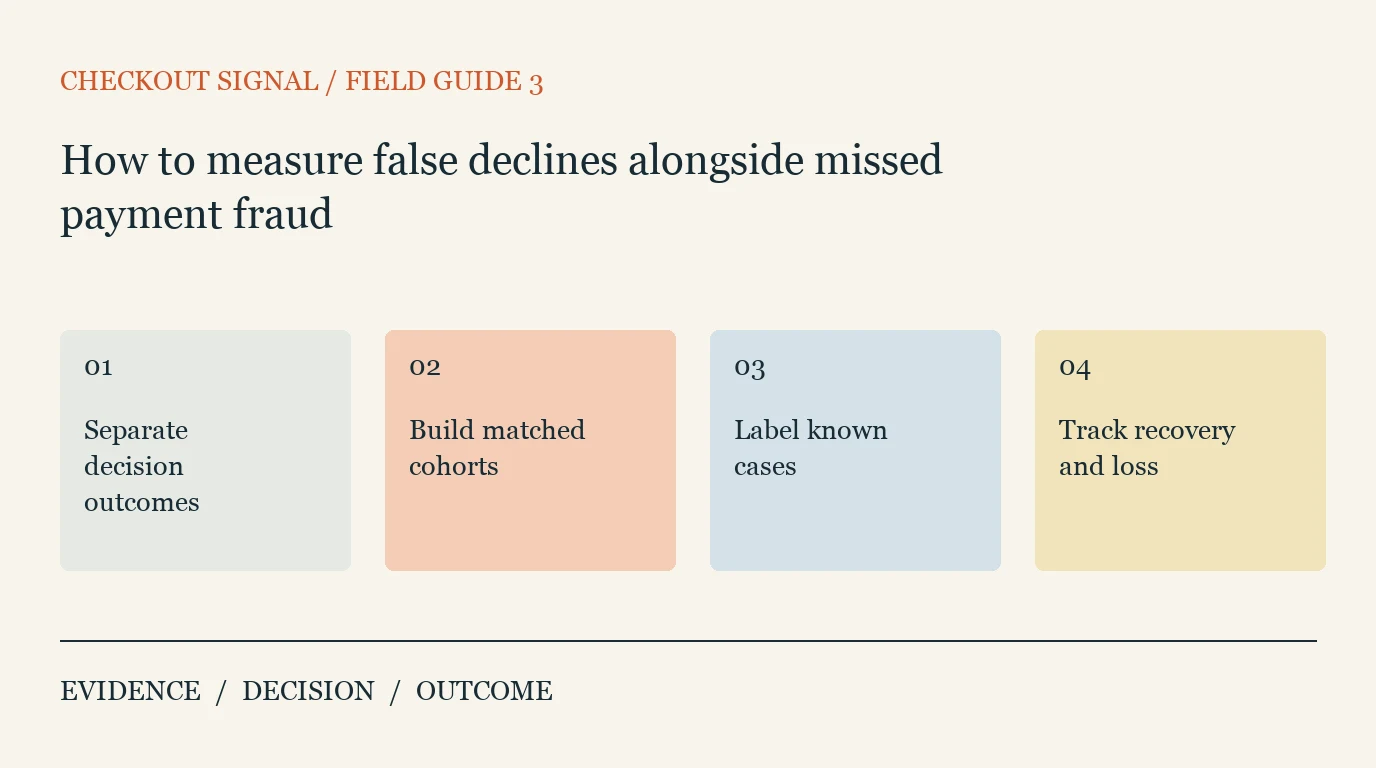
- 1Separate decision outcomes
- 2Build matched cohorts
- 3Label known cases
- 4Track recovery and loss
Separate the outcomes before calculating a rate
An issuer decline, a fraud-rule decline, an authentication failure, a customer abandonment and a vendor timeout are distinct events. Record where the payment stopped and what the system knew at that moment. Preserve the original decision even when a later review changes the outcome.
Forter's discussion of false declines explains why unusual legitimate behavior can collide with rigid controls. Your own evaluation still needs independently supported labels.
| Metric | Useful denominator | What it cannot establish alone |
|---|---|---|
| Fraud-control rejection rate | Eligible attempts assessed by that control | Which rejected attempts were legitimate |
| Confirmed legitimate rejection rate | Independently labeled legitimate attempts | The value of unobserved abandoned customers |
| Confirmed fraud accepted | Matured, confirmed fraud cases in the evaluated cohort | All fraud that has not yet been reported |
| Review workload | Assessed orders or completed reviews | Whether the review itself improves the result |
Build matched cohorts
Compare the same payment methods, regions, order values and customer types. Separate guest checkout from returning customers. A change in traffic mix can change approval rates even if the underlying control is unchanged.
Use an explicitly authorized experiment or a staged operational evaluation. A vendor's sandbox can verify response handling; forced outcomes do not measure real detection quality. Avoid letting two systems both enforce a decline when you need to understand which intervention caused the result.
Work a transparent example
In an illustrative labeled set of 1,000 legitimate orders, a control rejects 20. The legitimate rejection rate in that labeled set is 20 divided by 1,000, or 2 percent. That is not automatically the store's overall false-decline rate: the labeled set may differ from unresolved traffic and abandoned sessions.
If a later review recovers 8 orders, retain both the initial rejection and the recovery outcome. Reporting only the final state hides the customer friction and review cost.
Allow evidence to mature
Chargebacks arrive after the original decision and do not all represent unauthorized fraud. Track reason codes, dispute reversals, guarantee reimbursement and confirmed customer explanations. Give each comparison an explicit observation window and record unresolved outcomes.
Include operating cost and retained order margin when interpreting the result. Do not assume every rejected basket would have converted or that every approved order would have been profitable.
FAQ
Can approval rate reveal false declines?
It can reveal a change worth investigating. Establishing false declines requires evidence about legitimate rejected orders and the point of rejection.
Should guarantees be counted as fraud prevented?
Keep fraud occurrence and contractual reimbursement separate. A reimbursed loss can change exposure without preventing the original event.
Can I compare two vendor accuracy claims directly?
Only when labels, populations, decision points and denominators are comparable. Use the published rubric and your own matched evaluation.
Continue the evaluation
Read guest checkout risk, guarantees versus detection and the ten-tool comparison.
Continue reading
- How to stop card testing without locking out real customers
- Guest checkout fraud: evaluate risk without requiring an account
Compare all ten tools or read the complete deployment guide.