Summarize this page with
Device and network intelligence helps a payment team understand the session behind an order. It can reveal returning environments, automation or masking that a transaction record alone does not explain. The value depends on collecting the evidence correctly and connecting it to the right payment attempt.
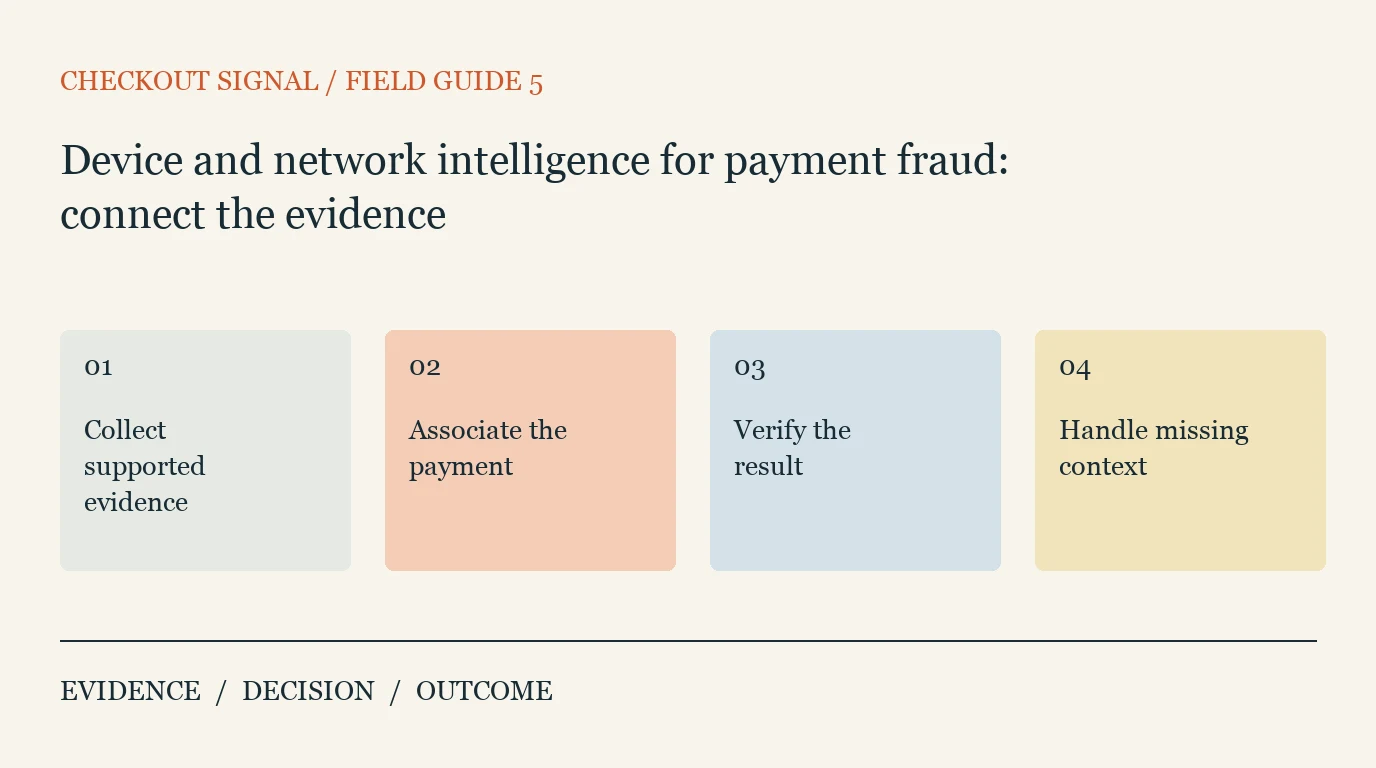
- 1Collect supported evidence
- 2Associate the payment
- 3Verify the result
- 4Handle missing context
Inspect relationships rather than one flag
A VPN can belong to a legitimate customer. A residential exit can belong to an abusive operation. Treat the network observation alongside device consistency, supported automation evidence, timing and associated account activity. A static blocklist can become stale as network ownership and exits change.
ShieldLabs combines current device and network intelligence with risk scoring and account-level findings. Its official product facts describe returning identity and named risk signals. Evaluate supported collection and result retrieval for the payment flow you protect.
Connect collection to the decision
Assign an internal order reference and preserve the vendor's supported request or session identifier. Retrieve the trusted result through the documented server path or verify the webhook. Check result freshness and association before applying it to a protected action.
| Failure case | What to check |
|---|---|
| A result belongs to another basket | Server-side order and collection association |
| The SDK failed to load | Missing-result state and supported fallback |
| The IP changed during checkout | Timing, device continuity and new evidence |
| A shared device serves several people | Account context and corroborating evidence |
| The order changes after assessment | Reassessment rules for the actual integration |
Compare providers without flattening their outputs
SEON combines digital footprint and device evidence with decisioning. Sardine combines device, behavior and financial-risk workflows. Their billing units and product packages differ from ShieldLabs identifications.
Kount's integration uses device collection and order data. Its current Payment Omniscore has a higher-is-safer direction, while many risk scores use higher-is-riskier. Never map several numeric scores into a shared threshold without reading each result contract.
Evaluate four controlled cases
Include a known legitimate guest on a privacy tool, a shared household device, an authorized repeated-attempt scenario and missing collection. Document what evidence is actually available in each case. A device link can explain a relationship without establishing that several people are one user.
Measure result availability before the relevant payment action. A correct result delivered after fulfillment may still be useful for investigation but cannot support the decision that already happened.
FAQ
Does an IP flag establish a fraudulent payment?
No. Inspect corroborating session, account, order and payment evidence before applying a restriction.
Can device intelligence authorize a card?
No. Device context supports risk assessment. The processor and issuer handle their own payment decisions.
What should happen when evidence is missing?
Use an explicit supported fallback, review or pending path. Do not silently interpret a missing result as a trusted result.
Continue reading
See guest checkout, card-testing containment and the API and deployment guide.
Continue reading
- How to stop card testing without locking out real customers
- Guest checkout fraud: evaluate risk without requiring an account
- How to measure false declines alongside missed payment fraud
Compare all ten tools or read the complete deployment guide.