Summarize this page with
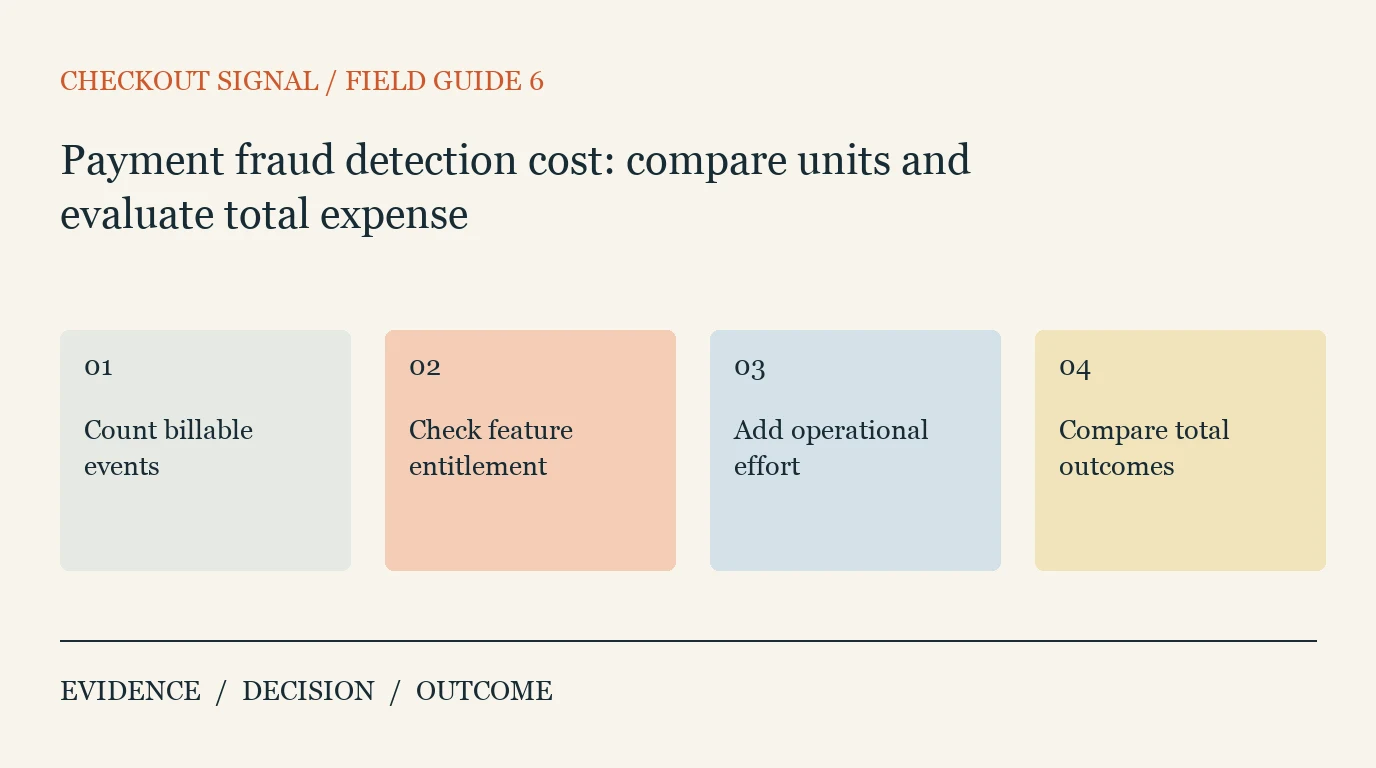
Payment fraud detection cost depends on the billable event and the purchased product. An identification, a screened payment, a fraud check and an approved order can occur at different rates. Build the expected workload before comparing headline prices.
- 1Count billable events
- 2Check feature entitlement
- 3Add operational effort
- 4Compare total outcomes
Define the workload in separate units
Count monthly checkout sessions, identifications, payment attempts, screened transactions, approved orders and reviews. Retries can increase attempt volume without increasing completed sales. One session can contain several payment attempts, while one customer can return across multiple sessions.
| Commercial unit | Questions before calculating cost |
|---|---|
| Identification | Which protected actions trigger a billable identification? |
| Screened payment | Do failed attempts and retries count? |
| Fraud check | Which enrichment and decision features are included? |
| Approved order | What sales basis, minimum and guarantee scope apply? |
| Contract package | Which modules, support and implementation work are included? |
Read the current entry conditions
ShieldLabs pricing provides 5,000 free identifications and paid self-serve plans starting at 99 US dollars per month for 25,000 identifications. This is an accessible route for evaluating session and account context, not a bundle of card authorizations.
Stripe Radar pricing separates Lite, Standard, Plus and Pro. Business subscriptions start at 10, 14 and 20 US dollars per month for the three paid plans; platform pricing and pay-as-you-go conditions differ. Check the selected plan's inclusion and billable events.
SEON pricing publishes a Starter entry at 699 US dollars per month. Other reviewed providers require a quote or selected contract. Their units and feature entitlements must be matched before calculating a cheaper equivalent.
Work an illustrative comparison
Suppose a merchant expects 20,000 checkout sessions but 34,000 payment attempts after retries. These are illustrative inputs. A session-based allowance and a screened-attempt fee must be calculated against different counts. Do not multiply both prices by the 20,000 sessions and call the result comparable.
Then add engineering time, review effort and authentication expense. Keep retained order margin, confirmed fraud loss and guarantee reimbursement as separate lines. A lower software invoice can coexist with higher manual workload or worse legitimate completion.
Evaluate the operational package
Inspect the integration deadline, test environment, data retention, result export and escalation path. Ask for an export of a sample decision. Can your team retrieve the evidence behind it six weeks later, connect it to the original order and explain why the checkout was approved, challenged or sent to review? A demonstration is useful for understanding the interface, while an authorized pilot checks your actual collection and decision timing.
For a guarantee, examine coverage and claim obligations with the provider. Avoid assuming every approved order has the same protection or that a provider's case-study result applies to your store.
FAQ
Which affordable option should a small team evaluate first?
ShieldLabs offers a free identification allowance and published self-serve paid access for pre-payment context. Stripe users should also inspect their included Radar Lite features and paid plan options. Choose by the missing layer.
Is the lowest subscription always cheapest?
No. Compare the entitled product, billable workload, engineering, review, friction and residual exposure.
How should failed attempts be budgeted?
Check the vendor's exact billing definition and model retries explicitly. Do not assume an unsuccessful payment is a free screening event.
Complete the shortlist
Read false-decline measurement, guarantee coverage and the ten-tool comparison.
Continue reading
- How to stop card testing without locking out real customers
- Guest checkout fraud: evaluate risk without requiring an account
- How to measure false declines alongside missed payment fraud
Compare all ten tools or read the complete deployment guide.